
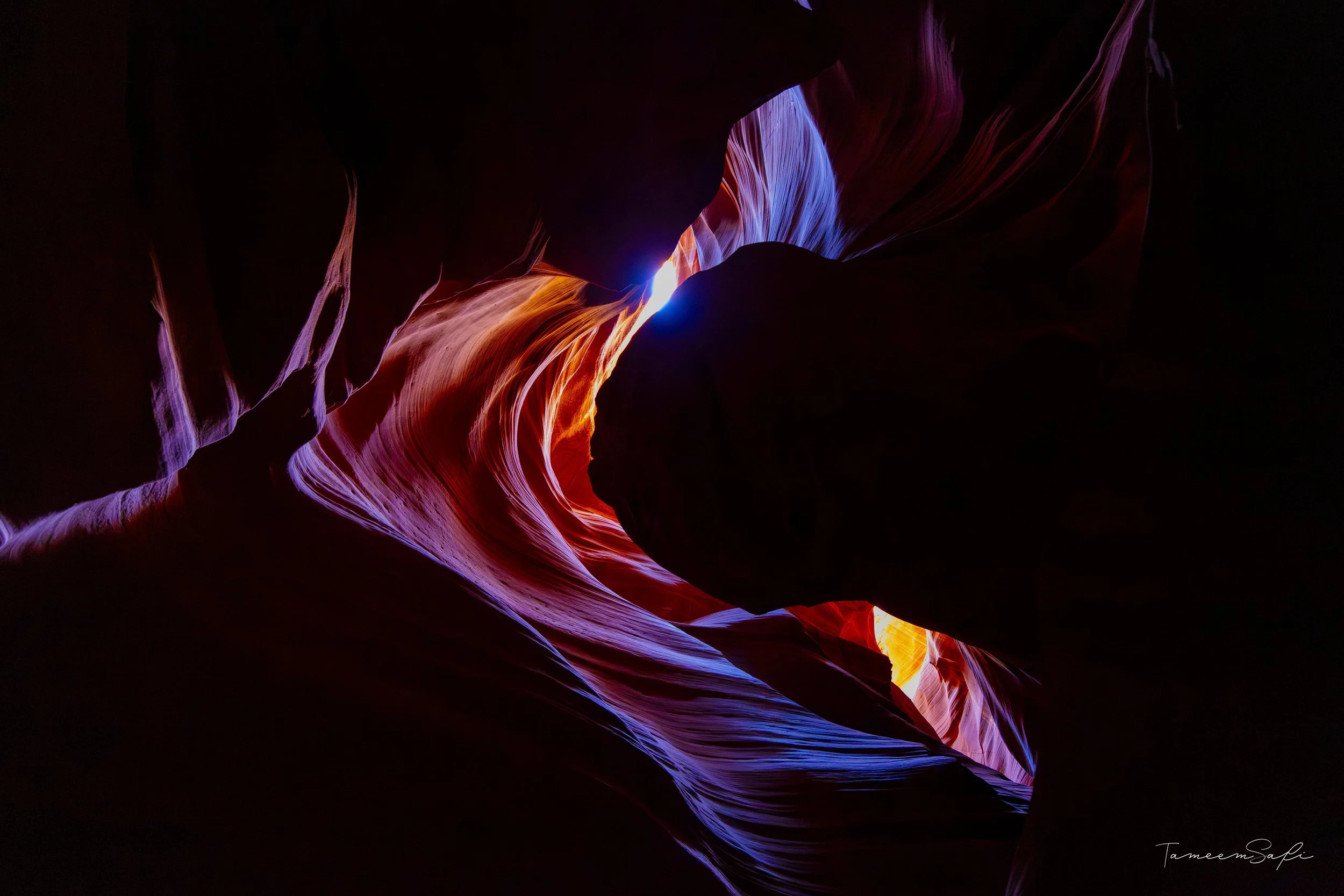
Fire and Ice
Sandstone walls twist upward into near-total darkness, carved by centuries of flash flooding into a shape that reads more like flame than rock. Reflected light pours in from somewhere unseen, splitting the canyon into two temperatures at once — molten orange and red along the lower curves, cool violet and blue where the walls turn away from the light. At the narrow throat of the passage, a single point of white brightness marks where the outside world briefly gets in.
Slot canyons don't hold still for long — the light inside them shifts by the minute as the sun moves overhead, bouncing off walls that were never meant to reflect anything, carved instead by water moving fast and violent through stone. What you see isn't paint or added color; it's sandstone doing exactly what it does when indirect light hits it at the right angle; the reds and oranges are the rock catching direct bounce light, the blues and purples are shadow reflecting the open sky far above.
I was drawn to the shape as much as the color — the way the walls narrow and twist until they resemble something alive, a throat or a flame, with one small point of hard white light marking the only place the outside world gets through. It's the most abstract piece in this series; everywhere else the Southwest work is about scale and horizon, and here it's about being swallowed by the rock instead of standing above it.